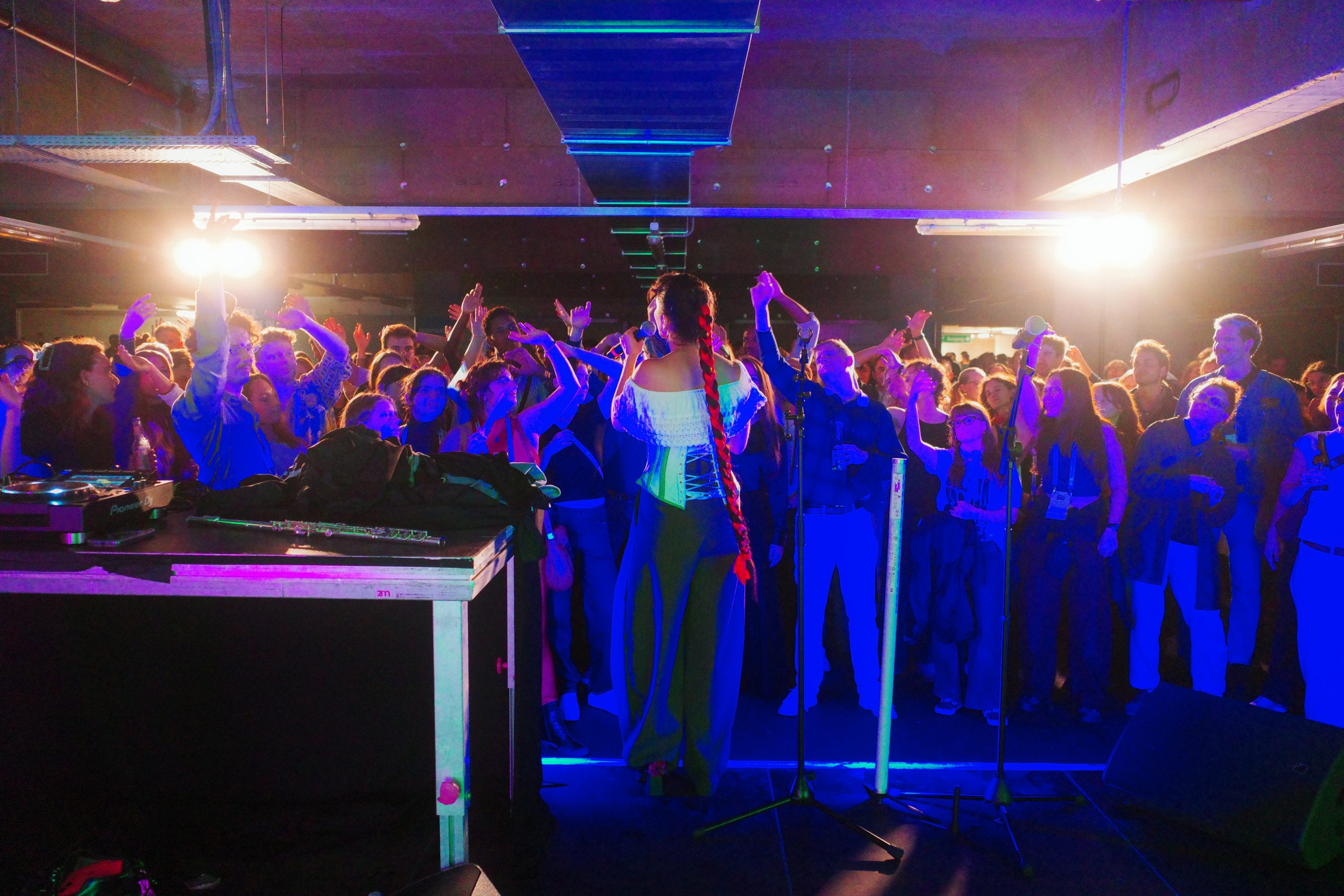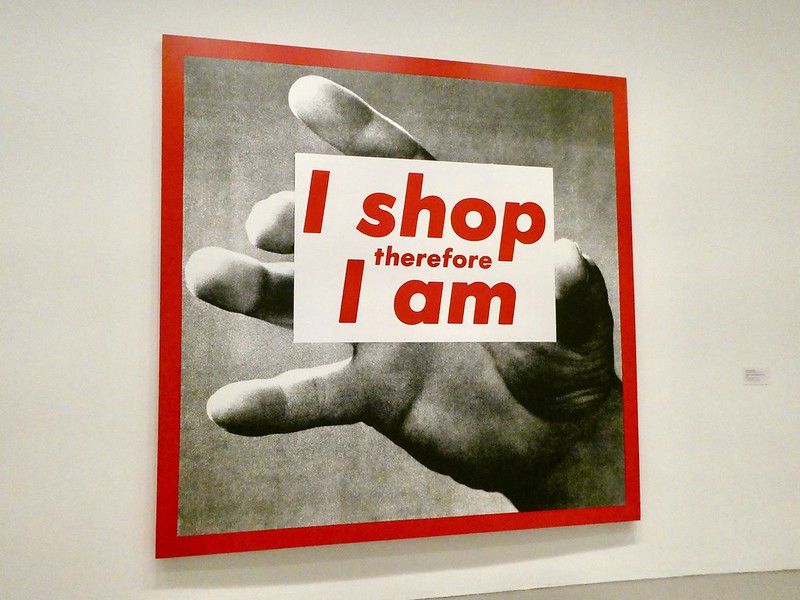
Cover: Artwork by U.S. concept artist Barbara Kruger. Photo Credit: F. Delventhal/krossbow
Tech billionaires are turning wealth into political power while citizens retreat into the habits of consumers. Resistance requires recovering imagination as a tool.
Forbes’s Real-Time Billionaires List lets readers watch fortunes rise and fall with each trading day. On 29 May 2026, it put Elon Musk’s net worth at $839.2 billion, up $1.2 billion in 24 hours. Staring back from this particular abyss are mostly the faces of rich men. Hardly a week passes without one of them expressing their visions for the future of the economy, government or society. To anyone who thinks of themselves as a citizen rather than merely a consumer, much of what they say sounds less like innovation than a particularly dystopian version of global oligarchy. Technological progress, once imagined as a collective good, increasingly appears to belong to a small group of strange billionaires.
Some propose colonising Mars or mining space for resources while their companies deepen environmental damage on Earth. Peter Thiel has argued that freedom and democracy are incompatible. Others imagine states run by chief executives rather than elected representatives. In the race for revenue and influence from AI, they compete to convince lawmakers and the public that only they can guarantee its safe development. The most aggressive ones work openly to weaken the institutions that might constrain them. Citizens appear in these visions mostly as users, customers, data points or obstacles.
Many people, through no fault of their own, now mistake the power exercised by these techno-feudalists for democracy itself. And when democratic institutions fail to restrain private power, democracy receives the blame. But it is not democracy who failed citizens, it is humans who failed democracy. It has been hollowed out by people who benefited from its protections and then turned against them. Promising innovation and deregulation, these actors attack the institutions that made their success possible. Simultaneously, many of us have neglected to defend our democratic systems and our rights against such greedy people.
Market Logic Colonialises Every Part of Daily Life
We have begun to accept the roles assigned to us. Many people increasingly understand their public worth through purchasing power. Social scientists describe the “consumer-citizen”: someone who approaches public life through choice, preference and exit rather than voice, obligation and the exercise of civil rights. The information age strengthened this identity by making it easier to learn about labour conditions or environmental damage and to express ethics through consumption. Responsible shopping matters. It becomes politically dangerous, however, when buying, switching or boycotting substitutes for collective action. Consumer habits can bleed into political life. When institutions frustrate us, we withdraw rather than organise, protest or demand change. In the 1980s, Jürgen Habermas warned that market logic was “colonising” the lifeworld: the realm of community, culture and meaning. The result is a thinner idea of citizenship.
Michael Sandel argues that market reasoning can crowd out moral reasoning. When everything is treated as a transaction, democratic participation is easily exchanged for passivity. Customers expect satisfaction and citizens cannot. Democracy requires people to remain committed to a process that often ends in compromise and sometimes in defeat. Yet we increasingly judge institutions by the standards of frictionless platforms. How badly are we failing democracy by expecting it to cater to our needs in the same way that an AI-backed online retailer would?
Discomfort is in the very nature of democracy, for it is a balancing of interests. If democratic institutions are to survive abuse by the powerful and neglect by the rest of us, citizens must accept that participation will not always feel rewarding.
Private power also depends on cultural legitimisation, so there is another culprit: the vain and cowardly intellectual, dancing on the razor’s edge. Many intellectuals condemn tech billionaires as dangerous until they can get them to speak at a panel discussion, boost a publication or generate attention online. Their greed for attention outwits their own moral reasoning. Audiences are customers to be acquired, attention becomes follower count, follower counts become book deals and invitations. The intellectual world is not outside market logic. It has learnt to monetise proximity to the people it claims to oppose. This is often defended as democratic openness: we must debate adversaries, speak to enemies and hear every position. Sometimes that is true. But the principle is applied selectively. The dissenter becomes interesting only once he is famous enough to draw a crowd. The quieter work of confronting harmful ideas before they turn into monsters is left to activists who may be mocked for their seriousness and idealism. In a world of horrible news, indifference is mistaken for sophistication and radical pragmatism is presented as virtue.
Democracy as a Service
In its winter 2025 issue, WIRED again ranked Europe’s 100 hottest start-ups. Many of these promise smoother consumer experiences or better tools for extracting value from data. This reveals how much talent is directed towards refining consumption rather than solving public problems. The profits generated by these systems are then converted into lobbying power. We finance companies as customers and later confront them as citizens, we are actively financing the erosion of our rights and institutions.
In wealthy democracies, we have been spoiled rotten. A lot of things around us are functioning requiring no other contribution from us than taxes and an occasional vote. Democracy begins to feel like a service rather than a system of shared ownership.
When it disappoints us, we behave like dissatisfied customers and exit the transaction. But there is nowhere outside the transaction to go. Withdrawal as a citizen is very different from withdrawal as a consumer: it doesn’t punish the powerful, it rather enlarges their room to act.
Not All is Asleep
In May 2026, Pope Leo XIV called for AI to be “disarmed”, to be freed from the logic of domination and be placed under human responsibility. Graduates have booed AI-themed commencement speeches, while former Silicon Valley employees increasingly warn about the systems they helped build. Gone are the times when we hoped AI would do the work that ruins people’s bodies and minds, and frees up our capacities to finally actively participate in society, take care of our families, work creatively or just do nothing. People are beginning to distinguish between innovation that expands human agency and innovation that reduces it, they are beginning to feel a threat to their individual lives. Job applications offer an example. Many employers use software to screen CVs and cover letters for keywords. Applicants must write simultaneously for a person and for an unknown machine, without knowing which one will make the first decision. A tool sold as efficiency for the employer becomes opacity and conformity for the applicant. The company providing the screening system owns the progress. The person subjected to it experiences only the constraint.
Consumer power can sometimes be political. Boycotts have changed corporate behaviour, and ethical consumption can complement collective action. The danger begins when it replaces citizenship. What will become of us if we remain consumers and forget about ever having been citizens? Democracy requires people willing to organise, argue, lose, return and remain responsible for a world they share with others. Its basic demand is not permanent indignation but sustained participation, especially when participation is inconvenient.
In the same month as Pope Leo’s calls for disarming AI, the French philosopher and sociologist Geoffroy de Lagasnerie withdrew from a keynote speech at the Wiener Festwochen after learning that Peter Thiel had also been invited. On Instagram, he wrote:
“One cannot fear and fight fascism and reflect on strategies of resistance while legitimising one of its most active representatives or, worse, presenting him as an intellectual whose ideas we would calmly discuss and listen to in a conference room. Politics is neither a spectacle nor entertainment. It is wars, disease, poverty, racism, mass surveillance and incarceration that result from the policies of which Thiel is a fervent supporter and funder.”
While not the worst way of promoting one’s own image, this statement served to remind us that refusing to legitimise concentrated private power can itself be a democratic act. Techno-feudalists do not have a monopoly on imagining humanity’s future, unless citizens concede it to them. To resist their worldbuilding we’ll need to rediscover imagination as a revolutionary tool, and begin creating political choices of our own instead of adapting our expectations to the disappointing status quo.
References
Geoffrey de Lagasnerie on Instagram, 2026