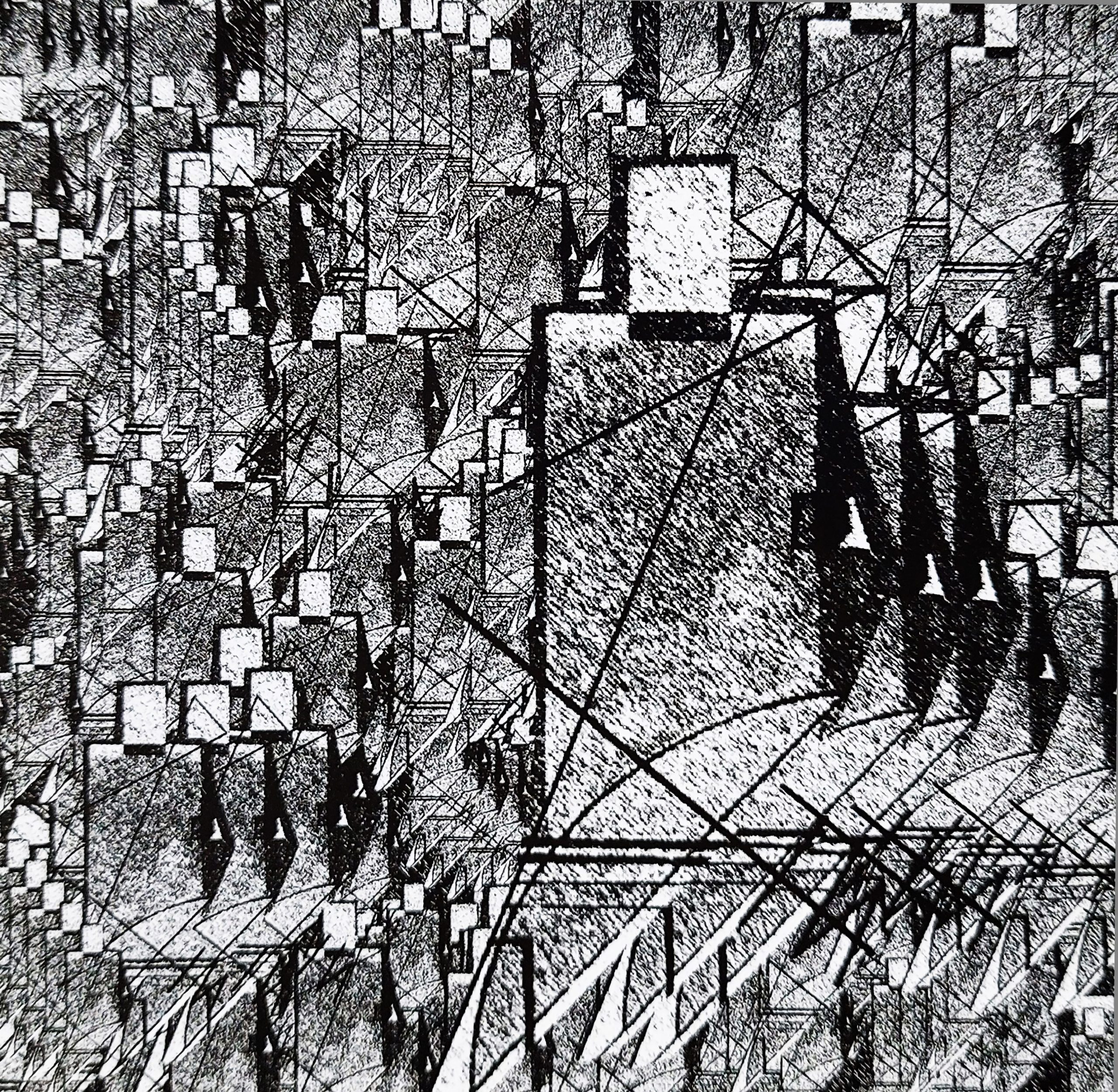
Cover: @ Dénes Ruzsa and Fruzsina Spitzer. Cosmic Chess. 2017
Born from catastrophe, Europe remains an unfinished metamorphosis.
Europe, for Morin and Ceruti, is a child of the improbable, and still an unfinished metamorphosis: a fragile possibility that emerged from catastrophe and could still fail. In its modern metanational form, Europe was born from resistance to barbarism. But barbarism, in this account, is not simply Europe’s opposite. It belongs to the same history, produced by the very civilization that gave the world humanism, universalism, democracy and scientific reason. To think Europe honestly, Morin and Ceruti argue, means holding these two truths together: refusing both self-absolution and self-hatred.
The metanational Europe of 1945 was born of resistance to Nazi barbarism and of the defense against Stalinist barbarism. The metanational Europe of 1989 became aware, somewhat belatedly, of the rebirth of nationalist barbarism, and rejected it just the same. The Europe of the past century was devastated not only by the barbarism that the advance of civilization has not yet managed to banish, but also by the barbarism produced by that very advance of civilization.
The new forms of barbarism that sprang from our civilisation did not diminish the old ones. On the contrary, they reawakened them and joined forces with them.
A rationalising, technological, scientific barbarism developed. This new barbarism not only made possible the devastating events of the two world wars; it also rationalised imprisonment in concentration camps, rationalised physical extermination with or without the gas chamber, rationalised torture.
For today’s Europe, resistance against barbarism is the core of a community of destiny which, out of the ashes of Europe’s divisions and conflicts, can allow us to bring forth dialogue and diversity lived as fruitful and productive. But upon a Europe that has become a province of the world, a Europe engaged in a new metamorphosis, a further step is now imposed. The tragic experiences of the past century must lead us Europeans to acknowledge barbarism fully for what it is, without simplification or falsification of any kind.
What matters is not repentance, but acknowledgment. This acknowledgment must pass through knowledge and through awareness. We must know what truly happened. We must be conscious of the complexity of this colossal tragedy. This acknowledgment must concern all the victims: Jews, Black people, Roma, homosexuals, Armenians, the colonised of Algeria or of Madagascar. Barbarism threatens us from behind the very strategies that appear to oppose it. We must not forget Hiroshima.
The reasoning that led to this new barbarism was an apparent logic, one that weighed in the balance the two hundred thousand dead caused by the bomb against the two million hypothetical victims that would have been the price of prolonging the war by conventional means. These figures, moreover, were deliberately falsified. But worse still, in the conscience of many Americans the Japanese were no more than sub-humans, inferior beings. And finally, this act of war contains a further ingredient of barbarism: the extraordinary advances of science placed at the service of a techno-scientific project for the elimination of a part of humanity.
We must be capable of thinking European and world barbarism in order to overcome it, for the worst is always possible. In the menacing desert of barbarism, we are at present under the relative protection of an oasis. But we also know that we live in the historical, political, and social conditions that make the worst imaginable.
Human history rarely follows the course that, at any given present moment, appears probable. The present does not know the innovation that has not yet occurred; it does not see the still-microscopic seeds that will undergo accelerated growth; it cannot foresee the effects of the countless inter-retroactions that constitute complex causality; it does not yet perceive the reversals of meaning and the permutations of purpose that characterise future processes.
The entire past of natural and human history is there to show us that evolution — understood as the creation of new possibilities — is such only when the course of events does not follow the probable trajectory.
Hypothetical futurologists observing the Earth in the Mesozoic era could not have foreseen that the enormous, heavily armored saurians that then reigned over our planet would soon vanish, making way for small, defenseless mammals. They could not have supposed that, within a plant world soberly dressed in green, so many multicolored flowers would suddenly burst forth.
In the same way, the whole adventure of Homo sapiens would have been inconceivable to hypothetical futurologists who had stood on the Earth a hundred thousand, or fifteen thousand, years ago. Who then, contemplating the human diaspora of small populations of semi-nomadic hunter-gatherers — without states, without cities, without agriculture — could have foreseen the appearance of cities, of states, of empires?
In the history of Europe, too, it has happened that the improbable supplanted the probable. Some 2,500 years ago, the most powerful empire of the age, the Persian Empire, launched an attack on the small and then-peripheral Greek cities, with Athens at their head. It was highly probable that the Persian Empire would crush these cities. There were two Persian wars. In the first, the Athenians and Spartans, united, repelled the gigantic invading army at Marathon. In the second, the Persians managed to take Athens and believed they had won. But the Greek fleet, at Salamis, laid a trap for the Persian fleet and destroyed it. This victory of the improbable marked the birth of Europe’s classical civilization, with all that it entailed for the development of democracy and of philosophy.
The metanational Europe of 1945, too, was born of the improbable. The fortunes of the Second World War underwent a dramatic reversal in the winter of 1941–1942. By then the Nazi armies, having occupied the countries of half of Europe, had reached the gates of Leningrad, of Moscow, and of the Caucasus. The reversal of the situation came about through at least three factors. The first is that Hitler, in the spring of 1941, had to delay his attack on the Soviet Union by a month, having first to crush the resistance of Yugoslavia, where there had been an anti-German, pro-British coup d’état. When Hitler launched the attack, on the 21st of June, this meant that the German army could reach Moscow only at the beginning of winter — a winter that came very early and was very brutal, and that immobilised it completely. A second factor lies in the fact that Sorge, a Soviet spy stationed in Japan, warned Stalin that the Japanese had no intention of attacking Siberia, because all their forces were concentrated on the attack against the United States, which then duly took place, at Pearl Harbor. Thus Stalin withdrew part of the troops stationed in the Far East and redeployed them on the western front. The third factor was that Stalin, finally, appointed General Zhukov to lead a Soviet counteroffensive that succeeded and drove the German army back. It may be added that, at the very moment of the Soviet counteroffensive, the United States also entered the war, in reaction to the Japanese attack. In just two months, the probable victory of the Nazis began to become improbable; the improbable victory of the Allies began to become probable.
The play of becoming is of a fantastic complexity. History innovates, drifts, hesitates. It changes course, it is diverted: the countercurrent stirred up by a current mingles with that current and, deflecting it, itself becomes the current. History is drift, deviance, creation. It is woven of ruptures, perturbations, crises.
Europe needs a new path. We Europeans must avoid at all costs the good conscience, which is always a false conscience. The work of memory must let the haunting of barbarism flow back toward us: the slave trade, colonizations, racisms, Nazi and Soviet totalitarianisms.
This haunting, integrated into the idea of Europe’s new metamorphosis, can make us capable of integrating barbarism into European consciousness — an indispensable condition if we are to overcome the new dangers of barbarism. But the bad conscience, too, is a false conscience. What we need is a double consciousness. To the consciousness of barbarism must be integrated the consciousness of the fact that Europe has produced — through humanism, universalism, the progressive rise of a planetary awareness — the antidotes to that very barbarism it has also spread across the world. This, too, is a condition for overcoming the ever-present risks of new barbarisms.
Nothing is irreversible, and the humanist democratic conditions must regenerate themselves perpetually, or else they degenerate. There are critical, uncertain situations. There are turning points at which history hesitates. A faint initial bending is therefore enough, a slight displacement, a chance event, one or several decisions, for the course of history to follow a different trajectory. Today the planet is in one of these situations, which we would call agonic. Agony means anguished struggle, inner conflict. Every birth is agonic, as is every death.
We are in the agony of a world that cannot manage to be born, because we are in the agony of a world that cannot manage to die.
Europe today lies at the periphery of the planetary Iron Age, and it cannot escape it alone. The thought and the culture of us Europeans — the fruit of our provincialization and of our awakenings — appear to us weak and threatened on every side. But we may hope that this weakness holds within itself the possibility of a metamorphosis of Europe, and the possibility for Europe to contribute to the metamorphosis of the world.
To understand what a metamorphosis is, let us think of how a caterpillar transforms into a dragonfly. The caterpillar has shut itself within the chrysalis. All at once, the phagocytes that ought to defend it against external aggression turn upon the organism itself. They destroy its very organs, sparing only the nervous system, which preserves the identity of the being and governs its metamorphosis. All the rest of the organism is laid waste.
In this implacable destruction, the construction of a being is carried out that is radically new and yet just as radically the same. In this agony there is a death that is a birth. The new being seeks to break the chrysalis that has now become a prison. With terrible convulsive efforts it tries again and again to emerge. It will succeed, but little by little and with difficulty. Its wings will long remain heavy, glued to its body. But in the end, when nothing yet seems to herald it, the dragonfly will be able to take flight.
Unlike the insect, Europe has no preliminary program guaranteeing and regulating its transformation. It is not governed by any sort of central nervous system. And yet, in its case too, total devastation and destruction were required — those of the Second World War — for its metamorphosis to be able to begin. Some countries have thus generated a kind of peripheral nervous system to regulate their first organic exchanges. But the central nervous system, the brain of Europe, has not yet taken shape.
The metamorphosis is unfinished; we are neither caterpillar nor dragonfly. The decisive effort is still to be made. Unlike the caterpillar-dragonfly, we possess awareness. This counts. In the history of Europe, thought has counted. It is neither idealist nor utopian to suppose that today thought can help bring about the emergence of a Europe politically united and active in the world. But the real question is whether culture and education are today equal to the task of carrying this out. Never in the history of Europe have the responsibilities of thought and of culture been so formidable.
The excerpt comes from La nostra Europa, by Edgar Morin and Mauro Ceruti, published by Raffaello Cortina in 2025 in an expanded edition of the book they first brought out in 2013. It is the work of two thinkers of complexity asking what remains of Europe after the collapse of its old certainties, and what might still be born from that collapse.