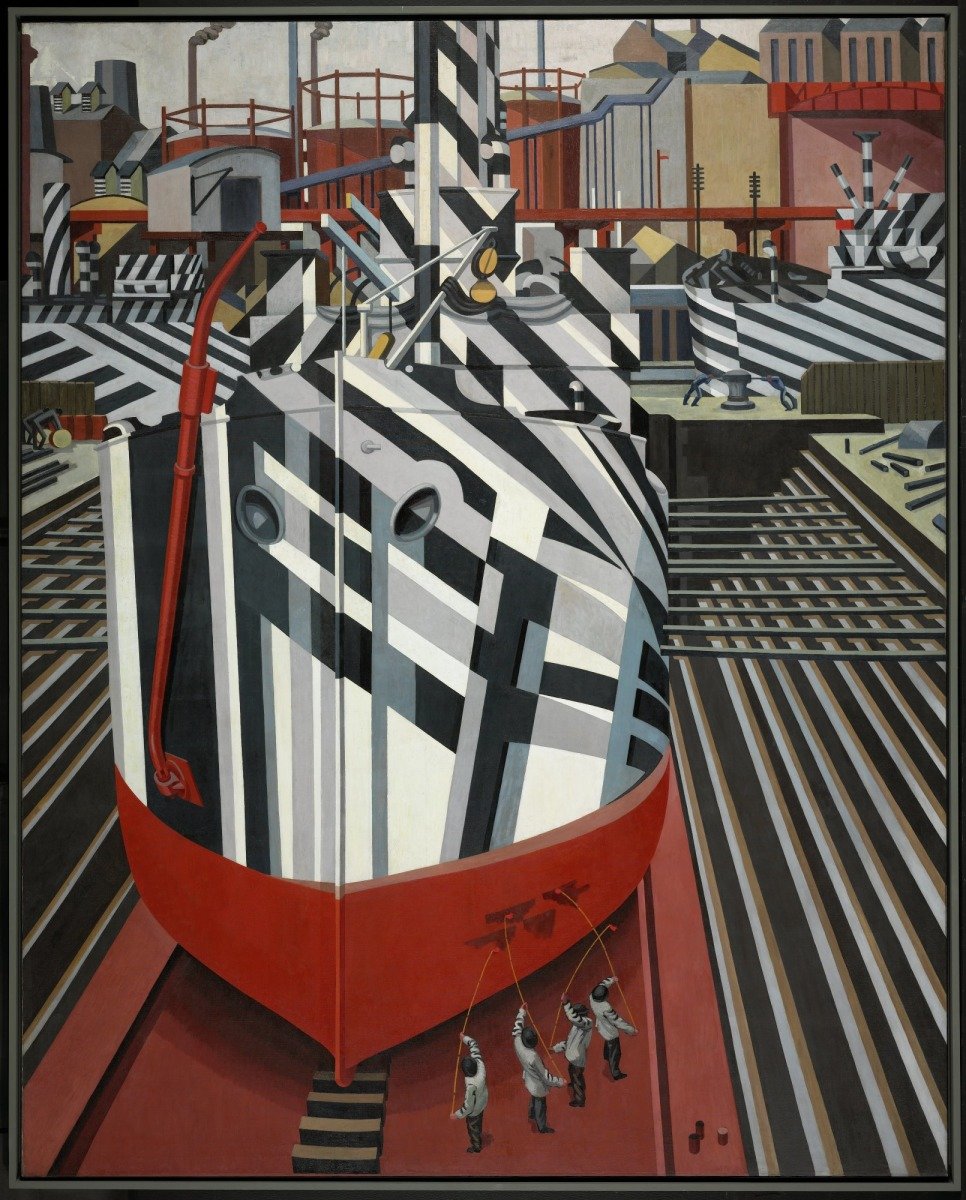
Cover: Edward Wadsworth, Dazzleships in Dry Dock at Liverpool, 1919. National Gallery of Canada, Ottawa. Photo © National Gallery of Canada.
Europe was built to make war unthinkable. It must now embrace Total Defence: organising the protection of peace across society as a whole.
“We do disagreeable things, but we’re defensive. Our policies are peaceful, but our methods can’t afford to be less ruthless than those of the opposition”. So explains Control, the British spymaster in John le Carré’s The Spy Who Came in from the Cold, as he prepares Alec Leamas for one more morally compromised mission in defence of the British state.
Le Carré wrote about espionage, deception, and the ambiguities of the Cold War. Yet the strategic dilemma he captured extends far beyond morally questionable intelligence work. Political communities organised around peaceful purposes – such as the European Union – still confront adversaries willing to exploit openness, dependency, and restraint. EU institutions may be liberal, their ambitions defensive, and their preferred instruments diplomatic or economic. None of this removes the burden of credible protection.
For much of the Post–Cold War period, Europe appeared to have solved this dilemma. Security rested on a familiar settlement: American guarantees under NATO, expanding economic interdependence, and the assumption that prosperity and integration would gradually domesticate geopolitical rivalry. Military power remained necessary, but largely receded into the background of European political life.
That settlement still exists, though it no longer structures European security with the same confidence. Russia wages territorial and hybrid warfare on Europe’s borders and beyond them. Strategic dependencies have become instruments of pressure. American commitments remain operational but politically contingent. Economic integration increasingly operates as terrain of competition and coercion.
Europe therefore confronts a strategic environment in which peaceful intentions alone provide little protection. The question facing the European Union is no longer whether it should speak the language of geopolitics. It already does. The deeper question concerns how an open political order defends itself when pressure and disruption increasingly shape everyday governance.
Europe’s response to this environment is often described as a geopolitical awakening or, more critically, as a turn toward militarisation. Both readings capture part of what is happening, yet neither adequately explains the direction of European policy.
The European Union is not preparing for territorial expansion, nor is it abandoning the liberal commitments that shaped post-war integration. Its institutions remain oriented toward cooperation, legal governance, and negotiated interdependence. Yet the conditions under which these institutions operate have changed. Security now extends far beyond armies and borders. It includes ports and power grids, semiconductor supply chains and telecommunications networks, election systems and information ecosystems, industrial production and access to critical raw materials.
This shift changes the meaning of defence itself. The strategic environment confronting Europe increasingly blurs distinctions that once appeared stable: civilian and military, domestic and external, peace and coercion. Hybrid attacks, cyber disruption, infrastructure sabotage, economic pressure, and foreign manipulation do not fit the classical grammar of war, yet they shape European policy with growing intensity. Conventional war does not define the experience of most European societies today, yet coercion increasingly shapes strategic planning and governance.
Under these conditions, the language of deterrence has migrated beyond ministries of defence. What is emerging instead resembles a continental logic of total defence: a framework that integrates military preparedness, economic security, democratic resilience, and strategic coordination into a broader architecture of protection. From the Preparedness Union Strategy and the European Democracy Shield to defence-industrial mobilisation, new security partnerships, and the accelerated integration of Ukraine, the European Union is assembling the instruments of a security model designed for endurance.
This is Europe’s total defence moment. Total defence refers to a whole-of-society and whole-of-government approach to security for conditions where pressure and coercion are constant and the line between war and peace is blurred. Put simply, it describes how states and societies organise themselves to deter escalation and avoid total war. Rather than relying on armies alone, total defence strengthens society’s capacity to withstand disruption and sustain political continuity. It protects institutions, infrastructure, and democratic life by combining military preparedness with economic security, technological resilience, and political coordination.
Total defence rests on a simple strategic logic. Rather than defeating an adversary through territorial conquest or overwhelming force alone, it seeks to shape adversary calculations in advance.
The objective is deterrence through endurance: convincing potential opponents that disruption will prove politically costly, economically futile, and strategically unsustainable because society itself has prepared to absorb pressure and continue functioning.
This strategic logic is hardly unfamiliar to Europeans, even if it has historically been organised at national rather than continental scale. Austria’s “Umfassende Landesverteidigung”, Germany’s “Gesamtverteidigung”, Finland’s comprehensive security model, Sweden’s revival of “totalförsvar”, and Estonia’s society-wide resilience strategies all rest on a similar premise: security cannot be delegated to armed forces alone. Public institutions, infrastructure operators, local authorities, private industry, and citizens themselves are expected to contribute to preparedness and deterrence. These models emerged from distinct historical experiences – Cold War neutrality, proximity to Russia, occupation, or vulnerability to hybrid threats – yet they converge around a shared insight. Modern conflict targets societies as much as armies. The European Union is not inventing this strategic grammar from scratch. What is new is the scale at which it increasingly operates and the institutional form through which it is being assembled.
Europe’s move toward total defence emerged incrementally, often through technocratic instruments that appeared disconnected when viewed in isolation. Taken together, however, they reveal a recognisable strategic logic. The first arena is societal resilience. In March 2025, the European Union launched the Preparedness Union Strategy, explicitly shifting from reactive crisis management toward permanent preparedness. Built on the Niinistö report’s call for an “all-hazards” approach, the strategy treats civilian and military preparedness as mutually reinforcing rather than institutionally separate. Critical infrastructure protection, emergency coordination, cyber resilience, strategic communication, and citizen preparedness now sit closer to the centre of European security planning than at any point in the Union’s history.
The European Democracy Shield extends this logic into the political sphere. Foreign interference, disinformation campaigns, and digital manipulation increasingly target democratic legitimacy itself. The Shield combines existing regulatory instruments – the Digital Services Act, AI governance, and electoral safeguards – with new mechanisms for election monitoring, fact-checking coordination, and protection of independent media. Defence, in this framework, begins with preserving democratic continuity.
The second arena is industrial and economic mobilisation. For decades, European defence debates centred on military expenditure while largely ignoring the industrial systems that sustain security. That distinction is disappearing. Through SAFE, joint procurement mechanisms, and the European Defence Industry Programme, Brussels increasingly treats production capacity, supply chains, and industrial coordination as strategic assets rather than market by-products. The €800 billion Readiness 2030 agenda reflects this shift. The significance lies less in headline spending than in institutional logic: defence production is becoming a matter of collective European capacity. Economic security now operates under the same rationale. REPowerEU, strategic technology policies, FDI screening, and the Anti-Coercion Instrument all respond to a shared concern: interdependence creates prosperity, but unmanaged dependency creates vulnerability. Europe is restructuring interdependence rather than retreating from it.
A third arena lies beyond the Union’s legal borders. Total defence increasingly shapes how Europe relates to partners and neighbours. Security and Defence Partnerships with countries such as Canada, Japan, South Korea, and the United Kingdom extend coordination across maritime security, cyber defence, and crisis response. Enlargement to Ukraine and Moldova follows a similar logic. Membership remains a political process, yet integration increasingly functions as an instrument of security governance. By extending legal, regulatory, and economic coordination into vulnerable spaces, the EU reduces strategic grey zones that adversaries can exploit.
Seen separately, these initiatives resemble sectoral policy adjustments. Viewed together, they reveal a deeper transformation. The European Union is organising security across society, industry, and geography simultaneously.
Sceptics may object that Europe is not constructing total defence so much as improvising under pressure. Defence spending remains uneven, strategic cultures diverge, and decision-making often appears fragmented. Preparedness strategies, industrial policy, and enlargement may therefore look less like parts of a coherent design than reactive responses to accumulating crises.
This criticism deserves serious consideration. European integration rarely advances through neat strategic blueprints. It develops through institutional layering, bargaining, and gradual coordination. Yet fragmentation should not be mistaken for the absence of direction. Across domains that once operated separately, a common strategic grammar increasingly appears: resilience, redundancy, deterrence, and democratic continuity.
Total defence ultimately depends on more than institutions and procurement. It assumes that societies recognise themselves as participants in a political community worth defending.
Here Europe faces a quieter challenge. Public support for stronger European coordination is high, particularly among younger Europeans, while willingness to bear the costs of physical defence remains uneven. Preparedness can be legislated. Political attachment develops more slowly.
European integration began as a peace project designed to contain the violence of Europe’s history. Its emerging security logic does not abandon that inheritance. It reflects a judgement that peace itself now requires organised protection.
Control’s logic in Le Carre’s novel was uncomfortable because it refused the innocence of good intentions. Europe occupies a different moral terrain, yet faces a related strategic problem: peaceful aims do not shield a political order from coercion, sabotage, dependency, or war. A Union built for peace must defend liberal democracy without losing discipline over the means it uses. That requires resilience, capacity, and political will strong enough to deter those who exploit openness, while preserving the openness that gives Europe its purpose. Europe’s total defence moment names that peace must be organised, financed, defended, and believed in before it is tested.