What makes people stand up to an illiberal regime, even when the cost is fear and isolation? Through the voices of resisting activists, journalists and researchers in Hungary and Serbia, this essay explores why they keep going.
“Are journalists in prison in Hungary?” “No, not at the moment.” “Can citizens compete freely in elections?” “Yes, they can.” “Well, then I do not understand. Is it a democracy or an autocracy?” For years, that was the question Western journalists asked us about Hungary and Serbia. The confusion is understandable. These regimes did not look like the dictatorships of the twentieth century. There are no tanks on every corner. No mass arrests of every critic. Elections were held. Parliaments met. But subsequently, new illiberal governments altered democratic rules and captured institutions of checks and balances in order to distort political competition for their own benefit. The core of democracy was being quietly hollowed out.
Illiberalism is neither an ideology nor a regime type, nor merely a checklist of institutional deformations, according to Zsolt Enyedi. Rather, it is the rejection of the core principles of liberal democracy: limited power, a neutral state, and an open society. Illiberal politics seeks to concentrate power, create a partisan state, and promote a closed society, each with characteristic manifestations. Open violence is usually avoided – until it isn’t. But these regimes are repressive from the beginning. Their repression is often invisible, subtle, deniable and psychologically exhausting.
Illiberal systems are characterized by majoritarian clientelism, in which survival—jobs, resources, and opportunities—is tied to partisan loyalty. The message is simple: your livelihood depends on your silence. These regimes strategically manufacture societal divisions.
By creating a permanent “us versus them” dynamic and portraying rivals as enemies, they suppress resistance while strengthening their support base.
By targeting independent academia, civil society, and the free press, they suppress alternative viewpoints and manipulate public narratives, creating the illusion that the regime is competent, inevitable and more than anything else unbeatable. Illiberal systems also instrumentalize fear through what Domonkos Sík calls a politics of “juggling with fear,” based on the narrowing of political agency, the reconfiguration of the public sphere, and the internalization of permanent uncertainty among citizens.
As a result of uncertainty and generalized fear, citizens adapt quickly. People, institutions, and even companies participate in the game of the ruling elite, benefit from the system, or simply learn to coexist with it. Those who disagree often choose exit over voice: they become apolitical or leave the country.
Only a few openly express opposition. We call them resisters. These are the people who refuse to pretend, and they are courageous.
In 2025, we interviewed 36 people in Hungary and Serbia who had openly pursued opposition activities for several years in order to slow down, stop, or reverse the actions of illiberal power holders. Who are they, and why do they choose to speak out despite the obvious costs? What dilemmas do they face, and how do they cope with them? We found that the civil society activists, journalists, and academics who voiced criticism openly were typically members of the cultural elite, established or nascent. This is perhaps unsurprising.
Cultural elites possess the knowledge necessary to identify systemic injustice and the failures of illiberal rulers, and they often have social networks that provide some protection against negative consequences. Yet most members of the cultural elite chose accommodation rather than resistance. Membership in this group was therefore not a predictor of becoming a resister. Nor was it evident that resisters came from liberal or intellectual families.
One of our most important findings is that many interviewed resisters were first-generation intellectuals who grew up far from elite circles. Their upbringing did not determine their future resistance. The qualities they shared were intellectual curiosity, a strong moral sense and social assertiveness, regardless of social background. Intellectual curiosity often emerged early in life. “I was really, really interested in reading, so my entire childhood was spent reading, even though we didn’t have a single book at home. Everything came from the library until I started buying books myself,” said Zoltán Varga, owner of one of the few Hungarian independent news media who was heavily attacked by Orbán’s government.
By the time they reached university, many already felt a desire to use their talents in socially meaningful ways. Dalma Dojcsák, leader of a human rights NGO recalls that “I found it pointless to just memorise laws. Fortunately, I quickly discovered the human rights track. It sparked my interest: a special course where we could analyze public policy issues, and where I also found a community.” Their key mentors and supporters were often teachers and colleagues rather than family members.
“Becoming a resister” occurred through different pathways. Some were naturally outspoken in the face of injustice and encountered resistance through their professional work—for example, as human rights activists. Most, however, became resisters through a gradual recognition of the repressive nature of the illiberal system around them. At some point, they experienced a triggering event that revealed the fundamentally unjust character of the regime and forced a decision: should they accept arbitrary and undemocratic rules, or resist them?
Sándor Léderer, anti-corruption activist in Hungary, recalls that in 2017, the ruling party accepted a law that required any organisation receiving more than €18,000, in foreign funding had to disclose on all public platforms that it was a ‘foreign-funded organization.’ “At that point, many people were still weighing up the possible consequences of a boycott, but we said that this was absolutely a yellow star mentality and could not be accepted.”
Mila Pajić, a student and one of the founders of a youth activist collective STAV (Students Against Authoritarian Rule), currently in political exile in Slovenia, described the experience that pushed her into activism as a moment of direct confrontation with electoral fraud in December 2023: “I witnessed firsthand what electoral fraud could look like. I experienced it directly—and I was furious. I think anger is perhaps the most necessary driving emotion behind activism.”
For the overwhelming majority of citizens, such moments led to adaptation and acceptance. Our interviewees chose resistance. At the time, they could not know how severe the consequences would become, and they took considerable risks. The costs of speaking up were real. Living under pressure in an illiberal system may not threaten personal freedom directly; instead, it creates an environment of constant existential insecurity. Szabolcs Panyi, Hungarian investigative journalist, recalled that “Rumors began to circulate that Index [an independent news portal] might actually come to an end in the foreseeable future because one of Orbán’s cronies would buy it. This kind of uncertainty about how long the paper would continue to exist was very depressing”.
Igor Bandović, Director of the think-tank Belgrade Centre for Security Policy, and a long-standing civil society activist, captured this recurring emotional burden when he admitted that “every time we fail, I feel frustrated.” Uncertainty itself can cause serious psychological distress and foster self-destructive coping mechanisms. It often leads to anxiety, chronic exhaustion, and burnout. Burnout, in turn, brings doubts about the purpose and meaning of one’s work. Constant stress and uncertainty strain family relationships and challenge personal integrity.
Harassment of autonomous organisations by a disproportionate volume of administrative burden and the constant existential insecurity became a normal condition for many civic organisations and independent media outlets. Many of them disappeared under the pressure. Those organizations that managed to continue soon faced a new challenge. Their leaders, activists, journalists, and publicly engaged academics faced public stigmatisation and a smear campaign.
Stefánia Kapronczay, a Hungarian human rights lawyer remembers that “In 2018, a few days after the election, I woke up to find that Figyelő [Observer magazine] had published a list of so-called “Soros mercenaries,” and I was on it.” At this point, she became really worried that she would be the target of some kind of violent action. Based on lies and disinformation, such campaigns aim to destroy the target’s professional reputations and isolate them within their communities and society at large.
Other forms of repression reported by interviewees included surveillance and intimidation. Tessza Udvarhelyi, a civic activist who protected people from forced eviction and who later became a local politician in Budapest, says that following the legal harassment she had to endure, she felt that she has been surveilled by the police for years. “I did not dare to go to certain places, not because I was afraid to be raped, but because of political reasons”. Maja Stojanović, a human rights activist and Executive Director of Civic Initiatives, described a moment when she felt completely unsafe “because the state would not only not protect you, but they themselves were the ones behind the attacks.”
A civic activist who protected people from forced eviction, says that following the legal harassment she had to endure, she felt that she has been surveilled by the police for years. “I did not dare to go to certain places, not because I was afraid to be raped, but because of political reasons”
Interviewees reported anxiety, isolation, helplessness, and sometimes depression. Surveillance and intimidation generated fear and insecurity by blurring the boundaries between professional and private life. Many interviewees were especially worried about their families. Srđan Marković, an activist from Belgrade, recalls threats directed at his mother: “Someone was threatening her with rape and murder… that’s when I became seriously scared.”
Although some individuals manage stress better than others, all interviewees described prolonged anxiety. During several year-long resisting activities, they lost opportunities and prospects. They felt trapped in their jobs and left behind in their careers. Financial advancement appeared out of reach. Impact of smear campaigns and stigmatisation become tangible.
József Péter Martin, an economist and anti-corruption leader, recalled that a head-hunting company which had previously contacted him later told him that, as long as the regime remained in power, he would not find work in the business sector: “Because there is that label on me, and no one will dare to employ me.”
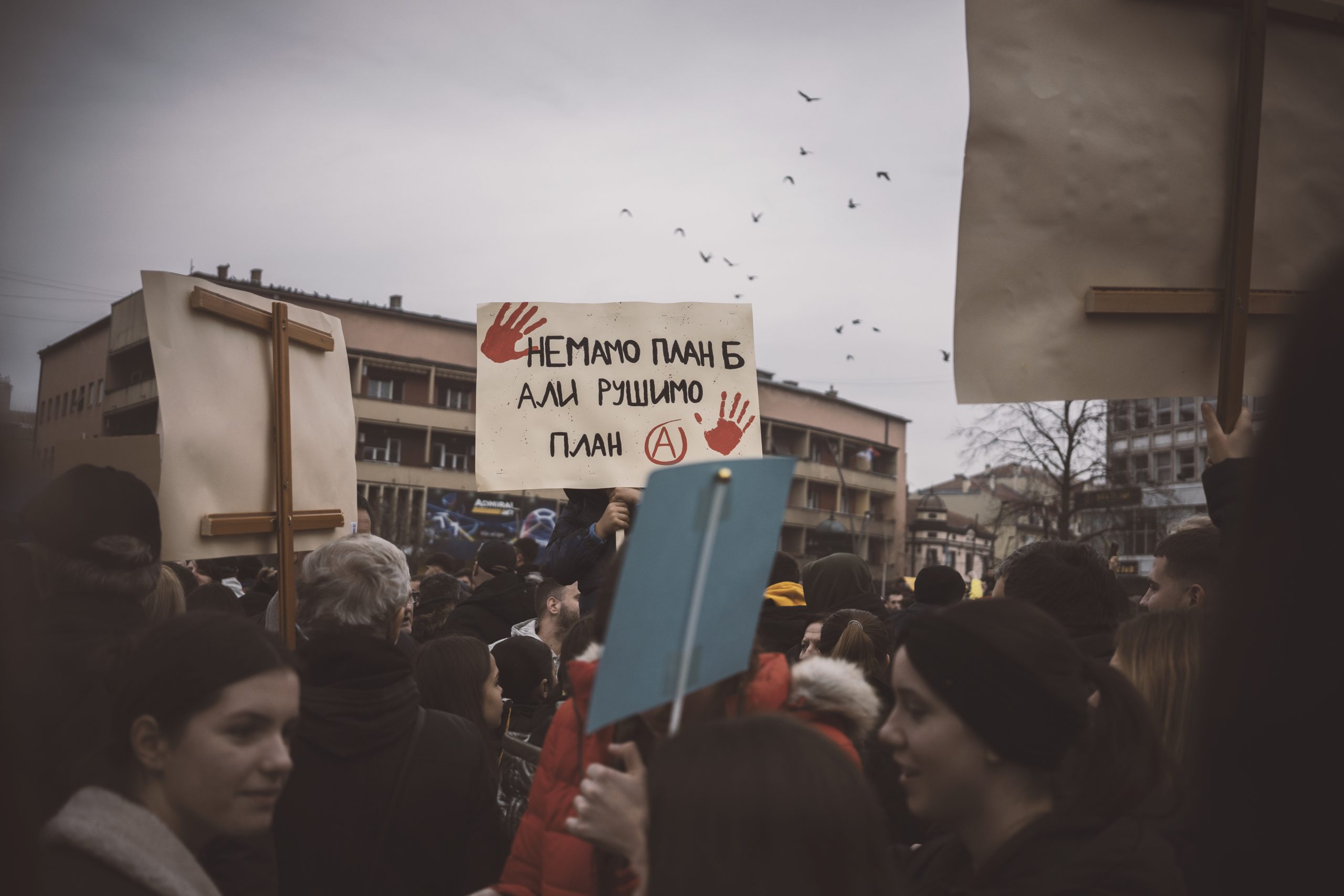
While physical violence and direct attacks were largely avoided by Viktor Orbán’s regime in Hungary, Aleksandar Vučić’s government in Serbia increasingly resorted to such methods following the 2024 Novi Sad disaster. When a newly built railway station partially collapsed, killing sixteen people, mass demonstrations erupted across the country. Mihajlo Botić, a student and active participant of ongoing protests, describes one particularly tense protest encounter, when masked men surrounded him and his colleagues: “We suddenly found ourselves walking straight into a group of maybe thirty or forty guys in balaclavas, carrying bats and iron bars. We just covered our heads and walked, hoping they wouldn’t touch us.”
Several organizers were arbitrarily arrested, informally detained, and harassed. Authorities operated in legal grey zones to deter young activists from continued resistance. Lazar Dinić, one of the founders of STAV, spent two and a half months in prison followed by another five months under house arrest on fabricated charges, described the first 48 hours in a dark cell with no sense of time: “There’s no light at all… excrements on the walls… you don’t know what time it is, whether it’s day or night.”
Interestingly, we found that resisters experienced relatively few moral dilemmas. This is understandable, as they generally followed a strong internal moral compass. Their dilemmas typically arose from professional ethics—for example, protecting the identity of information sources—or from leadership responsibilities, such as shielding colleagues and subordinates from increasingly severe consequences. Stefánia Kapronczay described difficult cases in which victims sought legal protection from the human rights team after facing serious injustice, but the organisation had to turn them down. As she explained, “legal action was unlikely to succeed and might not improve either the victim’s situation or the broader cause.”
One particularly common dilemma stemmed from the toxically polarized political arena in these illiberal states. Civic activists and journalists alike initially tried to remain equally distant from all political camps and maintain some dialogue with ruling party politicians and partisan media. Eventually, however, they had to acknowledge that this was impossible. Power holders refused to engage with them, instead labelling them enemies of the state. Over time, however, acceptance of this reality often brought relief from fruitless efforts and constant anxiety.
Identifying with the role of “resister” was itself a learning process. Those who sustained resistance over long periods developed a range of individual and collective coping strategies. Sharing problems with family and friends was the most natural response, but often insufficient. Many sought professional psychological support during particularly difficult periods. They learned to share responsibility, manage their time, and repeatedly rediscover purpose after highly stressful and frustrating experiences.
Márta Pardavi, co-chair of the Hungarian Helsinki Committee, explained: “Obviously, it’s strange at first when you see your name appear for the first time, but then you just get used to it. We learned very quickly that these things are not about you. They don’t want to deal with the issue you raise, they want others not to believe you. They want to discredit you, humiliate you, pigeonhole you. I think if you can rationalize what their goal really is, then I don’t think one gets very upset about it.”
As Maja Stojanović explained, her way of coping with fear was “to imagine the worst-case scenario that might happen, and then come to terms with it,” adding that “once I do that, I’m okay.”
Some managed to transform anger into action. They learned to take pride in small successes and preserve their dignity over time. Taking breaks—even brief ones—proved essential. International travel, conferences, and exchanges with peers facing similar challenges often restored energy and motivation. Encounters with colleagues living under even more repressive regimes fostered humility and solidarity, helping interviewees view their own struggles from a broader perspective.
This research offers important lessons for resisters worldwide and for those seeking to support resistance to illiberalism. First, it is essential to recognize that illiberal systems are oppressive systems. Their aggression is rarely physical; instead, it takes the form of threats, intimidation, humiliation, and isolation, exploiting power asymmetries to make citizens feel powerless, distressed, and insecure. Second, collective learning among resisters is crucial. It helps individuals care for themselves while also understanding the limits of the system, enabling them to take calculated risks. Strategic risk-taking allows resisters to continue their work and gain invaluable knowledge about how these systems operate. Such knowledge becomes particularly important as regimes begin to weaken.
By 2025, both Viktor Orbán’s and Aleksandar Vučić’s regimes showed signs of exhaustion. In Hungary, the 2026 parliamentary elections offered a historic opportunity to challenge Orbán’s rule. Without courageous civic activists, outspoken scholars, and investigative journalists, citizens would never have learned how fundamentally weakened the system had become.
Illiberal regimes do not last forever. Their power depends on performance: the performance of good governance, the performance of democracy, the performance of stability and invincibility. But the abuse of power becomes more visible over time, and people turn against the power-holders. Once a critical mass of people stops believing in the show, the ruler faces a dilemma. In this situation, Viktor Orbán went on radicalising his tried and tested tools of legal trickery, conspiracy campaigns, and intimidation. But these illiberal techniques actually had the opposite effect.
After a sixteen-year-long rule, Orbán’s party suffered a massive defeat in the 2026 parliamentary elections. Orbán’s illiberalism collapsed as a house of cards and Hungary entered into a historic phase of complicated re-democratisation. In Serbia, however, Aleksandar Vučić further radicalised, started to use open violence and slid further into authoritarianism.
“Are journalists in prison?” “Mostly not, but they are threatened, smeared, and surveilled.” “Can citizens protest?” “Yes, but protesters are beaten and arrested.” “Can young people speak freely?” “Some can, but others are in jail facing outlandish charges of trying to overthrow the constitutional order.” Vučić’s Serbia is showing how quickly the velvet glove can fall away. The ghosts of authoritarianism were always there, and now they are becoming visible.
Like all forms of political bullying, illiberal regimes leave behind profound social and political damage. Those who have resisted them throughout their existence will play a vital role in the difficult process of post-illiberal democratic restoration.